WarmerlyWarmerly ahead on this row
SPF, DKIM, DMARC and MX every six hours with 16 blocklists, and a placement test with limited accuracy.
One row, in depth: what each tool does, the verified numbers, and who each suits.
Closely details read from its pricing page, home page, product and legal pages and help centre on 21 October 2026.
SPF, DKIM, DMARC and MX every six hours with 16 blocklists, and a placement test with limited accuracy.
Not listed. Its help article points to outside tools for each check.
Warmerly checks SPF, DKIM, DMARC and MX every 6 hours with 16 blocklists, and runs a placement test with limited accuracy. Closely lists no authentication or placement checks, and its help article sends you to outside tools for both. Last checked 22 October 2026.
SPF, DKIM, DMARC and MX every six hours with 16 blocklists, and a placement test with limited accuracy.
Not listed. Its help article points to outside tools for each check.
Who runs them
Closely's article is dated 18 April 2023, so the tools it names may have changed. Warmerly's placement test has no dedicated Gmail or Outlook seed list yet.
As each describes it
Checked for you
Checked by you, elsewhere
Closely does offer a custom tracking domain, one CNAME record, which it says should help deliverability.
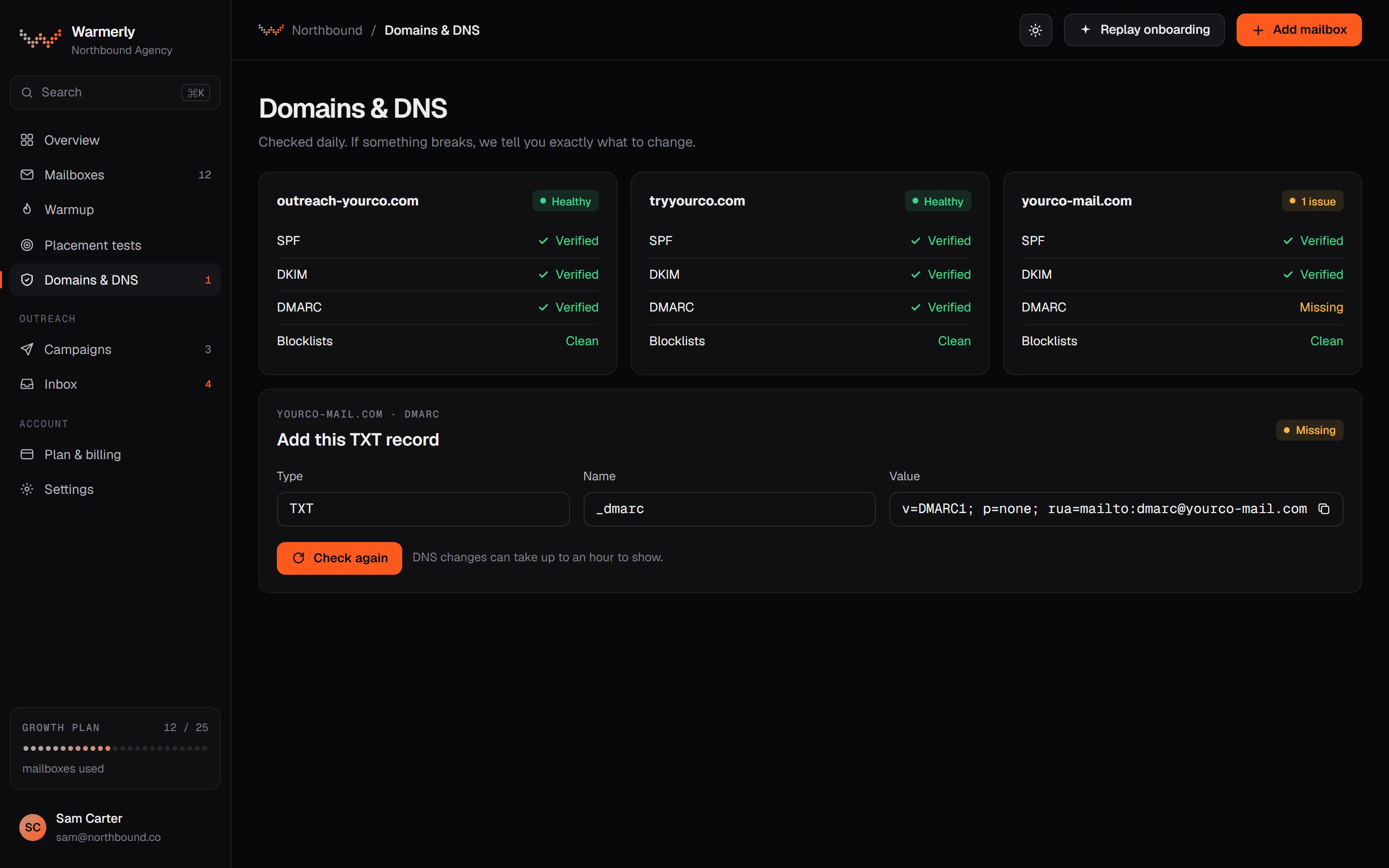
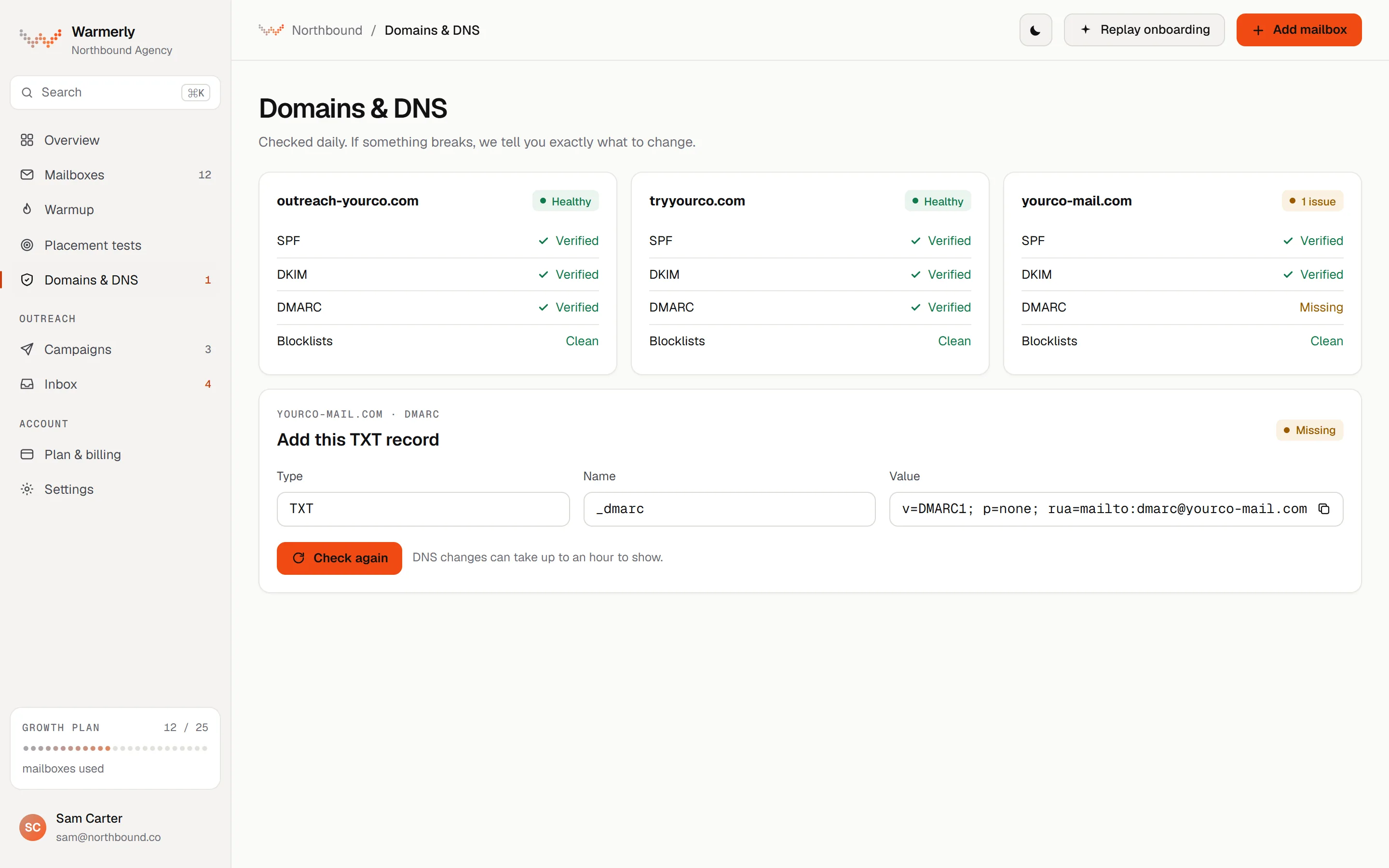
Records are swept every 6 hours with a written fix, and a placement test scores real results, with a stated limit on accuracy.
SPF is checked for its ending (-all, ~all, ?all or +all), for the limit of 10 DNS lookups counted through include and redirect, and for broken terms. DKIM is checked for key length (a 1024-bit key or shorter is flagged) and for the t=y test-mode flag. DMARC is checked for p=, sp=, pct= and whether rua= is set. MX is checked for presence.
Warmerly product, checked 21 October 2026
The records sweep runs every 6 hours by default across every mailbox that is not dead or paused. The mailbox's Health tab has a Re-check now option. Blocklist checks run on their own 6-hourly sweep.
Warmerly product, checked 21 October 2026
Each finding has a title, an explanation and a fix. For example, SPF needing more than 10 lookups is explained as receivers treating the record as a permanent error. DKIM in test mode says to remove t=y once signing is confirmed. Advisories such as p=none are shown but never red.
Warmerly product, checked 21 October 2026
Warmerly queries 6 domain lists (Spamhaus DBL, SURBL, URIBL, NordSpam DBL, Spam Eating Monkey URI, s5h) and 10 IP lists (Spamhaus ZEN, SpamCop, Barracuda, PSBL, Mailspike, NordSpam, Spam Eating Monkey, Lashback UBL, DroneBL, GBUdb Truncate) by plain DNS lookup. A refused query is never reported as a listing, and several well known zones are left out on purpose (SORBS, UCEPROTECT and Invaluement).
Warmerly product, checked 21 October 2026
It sends one message from the mailbox's own SMTP to up to 4 targets (2 on the same provider, 2 on another). After a wait of 30 seconds on demand, or 90 seconds in the daily sweep, it checks INBOX, Promotions, Spam and Junk over IMAP and scores each result: inbox 100, promotions 60, spam 10, missing 0. The scores are averaged.
Warmerly product, checked 21 October 2026
Real measurement needs seed mailboxes at Gmail, Outlook or Yahoo in the placement_seeds table. The doc's check on 2026-10-15 found that table has never held a real row in production, so every test falls back to Warmerly's own warmup-pool mailboxes.
Warmerly product, checked 21 October 2026
Warmerly's own mailboxes accept essentially everything, so a degraded score is about 100 whatever the sender's real performance. In code a degraded run never writes health, is excluded from the spam score and the warmup quota, and the account page shows a Limited accuracy note. A trend is shown only when the two latest tests are the same kind.
Warmerly product, checked 21 October 2026
Each test you start uses one of your monthly placement tests: 3 on Free, 5 on Starter, 25 on Growth and 100 on Agency. They reset on the 1st. A test that fails to run is handed back and does not count, and the automatic background tests Warmerly runs do not use your allowance.
Warmerly product, checked 21 October 2026
A custom tracking domain is set per mailbox with one CNAME record. Warmerly verifies the record, then checks that HTTPS works with a valid certificate. A domain that fails either check is not used: the mailbox sends with no tracking and no unsubscribe link until both pass. The launch check shows this as a warning, not a block.
Warmerly product, checked 21 October 2026
A campaign has a Send as plain text only switch that removes the HTML version, the tracking image and the rewritten links. The help page calls it usually the biggest single improvement to inbox placement for cold outreach, at the cost of open and click numbers. Open tracking is off by default for the same reason.
Warmerly product, checked 21 October 2026
The Inbox placement card shows a score out of 100 and one dot per target mailbox. Promotions is rarely reported for Gmail because Gmail's tabs are not visible to Warmerly, so a missing Promotions count does not mean nothing landed there.
Warmerly product, checked 21 October 2026
The help page lists the order: fix failing SPF, DKIM or DMARC, check for a blocklist listing, check the mailbox has warmed up (a mailbox in its first two weeks will not place well), check the copy, then wait a few days with warmup on and test again. One promotions result is described as not an emergency; the same mailbox in spam repeatedly is.
Warmerly product, checked 21 October 2026
No authentication or placement feature appears on Closely's pricing or product pages. Its help article lists outside tools for each check.
Its article on spam says to check SPF with mail-tester.com and links Google and Microsoft guides for DKIM and DMARC. It gives no in-app check.
help.closelyhq.com/en/articles/7321531-here-s-why-emails-go-to-spam · read 21 October 2026
It suggests sending a neutral test to seed addresses at gmass.co/inbox and checking which folder each lands in.
help.closelyhq.com/en/articles/7321531-here-s-why-emails-go-to-spam · read 21 October 2026
It suggests checking IPs with dnschecker.org and, if listed, contacting the blocklist provider.
help.closelyhq.com/en/articles/7321531-here-s-why-emails-go-to-spam · read 21 October 2026
Its help centre shows how to add a CNAME so tracking and unsubscribe links use your own domain, which it says should increase deliverability. DNS changes can take up to 72 hours.
help.closelyhq.com/en/articles/6868740-custom-tracking-domain · read 21 October 2026
The article gives bands (0 to 25% likely spam, 26 to 50% some marked as spam), which it does not source and which it says can have other causes.
help.closelyhq.com/en/articles/7321531-here-s-why-emails-go-to-spam · read 21 October 2026
The spam article is by Closely's help centre author and is dated 18 April 2023, in its Email campaigns collection. It names eight possible causes and says it is usually a combination of them.
help.closelyhq.com/en/articles/7321531-here-s-why-emails-go-to-spam · read 22 October 2026
Free accounts such as gmail.com or outlook.com, a domain bought less than a year ago, a sudden jump in volume (its example is 50 emails a day rising to 500 in one day), frequent complaints, links to a third-party domain, links to domains people complain about, trigger words, and missing DMARC, DKIM and SPF. It states these without evidence.
help.closelyhq.com/en/articles/7321531-here-s-why-emails-go-to-spam · read 22 October 2026
Adjust DMARC, DKIM and SPF, stop mailings or keep to about 50 messages a day, move part of the sending to an older domain if the domain is under a year old, warm up sending accounts gradually using tools from saleshandy.com, set up a custom tracking domain or turn off open and click tracking, and check the text for trigger words with autoklose.com.
help.closelyhq.com/en/articles/7321531-here-s-why-emails-go-to-spam · read 22 October 2026
Always reply to responses, even rejections, add an unsubscribe link or button, and if a reply asks you to stop, stop and add the contact to your sender blacklist.
help.closelyhq.com/en/articles/7321531-here-s-why-emails-go-to-spam · read 22 October 2026
In Outreach, then Accounts, choose a sending account, open Setup domains, enter your domain, then add a CNAME at your DNS host: host track, pointing to l.onthe.io. It covers the unsubscribe button, open tracking and click tracking, and the article is dated 31 January 2024.
help.closelyhq.com/en/articles/6868740-custom-tracking-domain · read 22 October 2026
The tracking article says the change takes up to a few minutes and also that DNS updates may take from a few minutes to 72 hours. It does not say how Closely confirms the domain works or what to do if setup fails. You can keep the default Closely tracking domain instead.
help.closelyhq.com/en/articles/6868740-custom-tracking-domain · read 22 October 2026
The spam article tells you to watch bounce rate, the share of emails returned undelivered, and gives no figure at which to act.
help.closelyhq.com/en/articles/7321531-here-s-why-emails-go-to-spam · read 22 October 2026
We looked, and found no statement on these. That is about its published pages only, not about the product.
We report each version rather than pick one.
| Measure | Warmerly | Closely |
|---|---|---|
| SPF, DKIM, DMARC and placement checks | SPF, DKIM, DMARC and MX every six hours with 16 blocklists, and a placement test with limited accuracy. | Not listed. Its help article points to outside tools for each check. |
| SPF, DKIM and DMARC checks | Every 6 hours, with MX and 16 blocklists | Not listed |
| Placement test | Up to 4 targets, limited accuracy | Not listed |
| Custom tracking domain | Warned about in the pre-launch checks | Yes, one CNAME |
| Placement tests a month | 3 on Free, 5 on Starter, 25 on Growth, 100 on Agency | Not listed |
| Blocklist checks | 16 lists, swept every 6 hours | By hand with an outside checker, per its article |
| Tracking domain setup | One CNAME per mailbox, verified, then HTTPS checked | One CNAME, host track, pointing to l.onthe.io |
| Dates of the guidance | Current docs and code | Spam article 18 April 2023; tracking article 31 January 2024 |
Our reading of the facts above. Not a promise, and not the only reasonable reading.
You run SPF, DKIM, DMARC, blocklist and seed checks with outside tools.
With a written fix for each finding. Its placement test has no dedicated Gmail or Outlook seed list yet, and says so.
Warmerly sweeps records every 6 hours, which is 4 checks a day. If you instead looked by hand once a week, a record that broke just after your check could go unseen for up to 7 days, which is 168 hours, or 28 sweep intervals. That is arithmetic on a habit, not a Closely figure: Closely's article gives no schedule, only tools to run when you suspect a problem.
Closely's route is to send a neutral message to the seed addresses at gmass.co/inbox and open each folder. Warmerly's placement test does a similar thing for up to 4 targets, 2 on the same provider and 2 on another, and shows a score. Until it has real Gmail or Outlook seeds the targets are its own warmup mailboxes, so the card says Limited accuracy.
A Starter workspace has 5 mailboxes and 5 placement tests a month, so one test each with nothing left over. Growth has 25 mailboxes and 25 tests, Agency 100 and 100. Warmerly's own background tests do not draw on that allowance.
On Warmerly, a mailbox without a working tracking domain sends no unsubscribe link and the email ends with a line asking people to reply unsubscribe. Closely's article tells you to add an unsubscribe link and, separately, to set up a custom tracking domain, and says the domain covers the unsubscribe button.
We found no in-app check. Its help article on spam tells you to check SPF with mail-tester.com and links Google and Microsoft guides for DKIM and DMARC.
Limited. Until real Gmail or Outlook seeds exist, a test measures delivery into Warmerly's own mailboxes, and the account page shows a Limited accuracy note.
We found none. Its spam article suggests sending a neutral test to seed addresses at gmass.co/inbox and checking which folder each message reaches. The article is dated 18 April 2023.
3 a month on Free, 5 on Starter, 25 on Growth and 100 on Agency. They reset on the 1st, and a test that fails to run is not counted.
Its help article calls it not necessary but something that should increase deliverability. It is one CNAME at your DNS host, and it covers unsubscribe, open and click links.
Closely pages were read on 21 October 2026. Plans and wording change, so check the vendor's own page before you decide. Warmerly details come from the product as it runs today.
Connect a mailbox. Warmerly runs alongside whatever you send from now, so you can compare before you move anything.
Free plan, no card. Paid plans: 7-day trial, first charge on day 8.