Warmerly
Email, wait, LinkedIn and WhatsApp steps with opened, clicked and replied branches; up to 4 variants per step
One row, in depth: what each tool does, the verified numbers, and who each suits.
Woodpecker details read from its pricing, home, features, integrations, agency and help centre pages on 21 October 2026.
Email, wait, LinkedIn and WhatsApp steps with opened, clicked and replied branches; up to 4 variants per step
Up to 16 steps per campaign; A/B testing with up to 5 versions
Both tools build a multi-step sequence, branch on how a prospect behaves and split-test the copy. Warmerly mixes email, wait, LinkedIn and WhatsApp steps, branches on opened, clicked and replied, and tests up to 4 variants per step. Woodpecker allows up to 16 steps, tests up to 5 versions per step, and has more kinds of condition. Woodpecker is ahead on versions per step and on condition types, and it gives sample size guidance. Warmerly is ahead on a visible winner rule and on putting WhatsApp in the same sequence. Last checked 22 October 2026.
Email, wait, LinkedIn and WhatsApp steps with opened, clicked and replied branches; up to 4 variants per step
Up to 16 steps per campaign; A/B testing with up to 5 versions
Warmerly's step kinds and branches, against Woodpecker's step ceiling and condition types.
A condition step sends each lead down the first branch that matches. A wait runs 0 to 365 days and 0 to 23 hours.
Six step kinds, four branch kinds. The branching editor is the only one that can build a condition.
Up to 16 steps. Emails, LinkedIn manual tasks and phone calls.
Four kinds of condition listed in the help centre. We read only the open-based article in full.
Versions per step, and how each tool says a test should be sized and judged.
4 variants per step. The next send goes to whichever has been sent least, so the split stays even.
5 versions per step, drawn at random just before each send.
| Tool | Steps | Branches | Versions per step |
|---|---|---|---|
| Warmerly | Email, Wait, LinkedIn connection, LinkedIn message, WhatsApp message, Condition | Replied, Clicked, Opened, Timeout | 4, labelled A to D |
| Woodpecker | Up to 16: emails, LinkedIn manual tasks, phone calls | Open-based, Click-based, Task-based, Snippet-based | 5, labelled A to E |
Woodpecker figures read on 22 October 2026 from its features page and help centre. Warmerly figures come from its step schema and engine code. Woodpecker is ahead on versions per step and on kinds of condition.
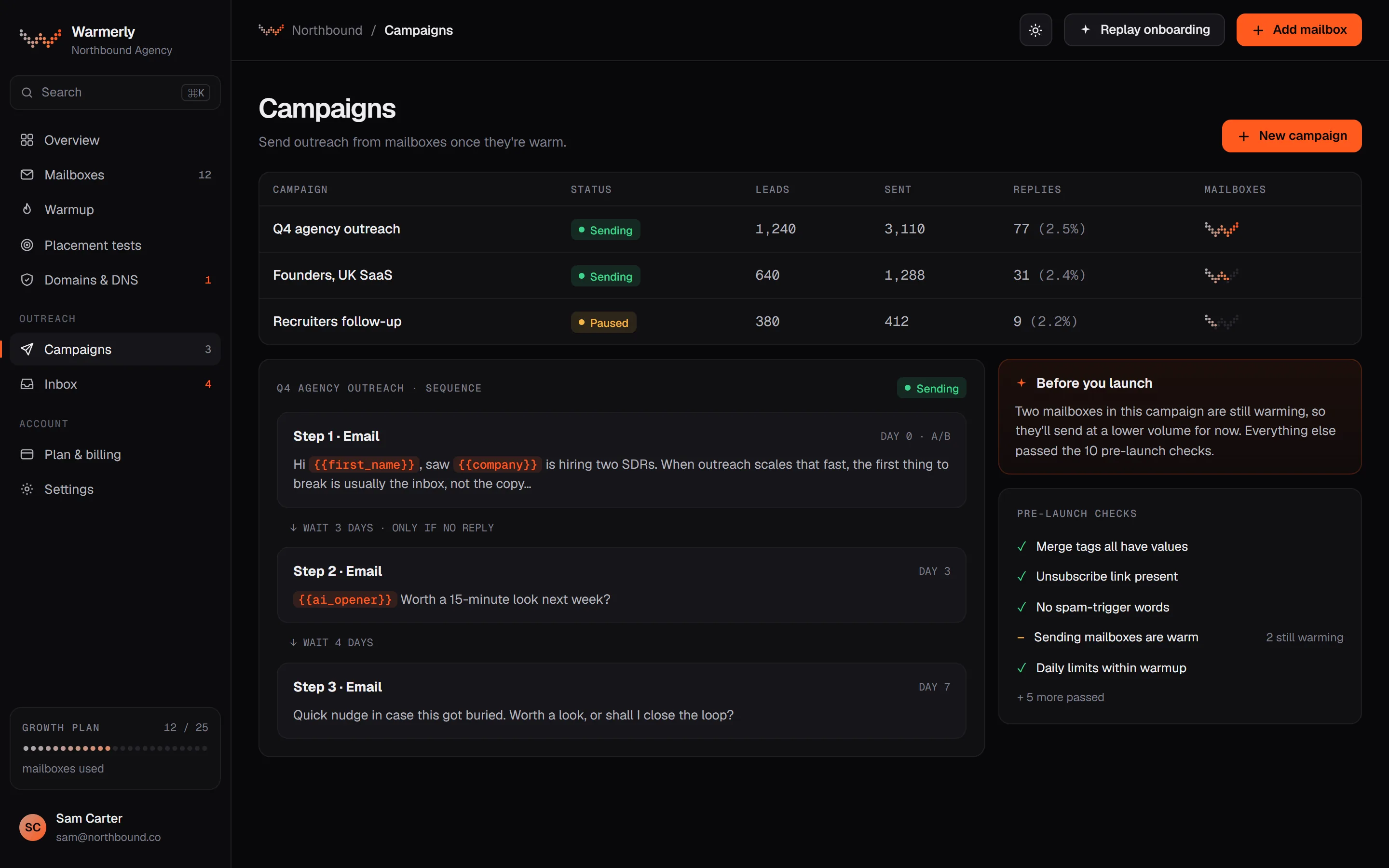
One sequence of email, wait, LinkedIn and WhatsApp steps, with branches on opened, clicked and replied and up to 4 variants per step.
A step is one of email, wait, LinkedIn connection, LinkedIn message, WhatsApp message or condition. Email, LinkedIn and WhatsApp steps are the ones that send something. Wait and condition steps only move a lead along. There is no phone call step in the list.
Warmerly product, checked 21 October 2026
Each step carries a delay of 0 to 365 days and 0 to 23 hours before it runs. The wait row shows the largest unit that fits the stored total, so a step saved as 1 day 12 hours reads as 36 hours. In the flat list shape, a wait entry simply adds its time to the next real step.
Warmerly product, checked 21 October 2026
A Simple list editor adds, reorders and deletes steps in a straight line. A Branching editor is a drag and drop canvas and is the only one that can create or edit condition steps. Both read and write the same saved sequence, and both autosave about 1.2 seconds after your last edit. The flat list shape the public API accepts holds up to 50 steps.
Warmerly product, checked 21 October 2026
A condition step waits for its set time, then sends the lead down the first edge that matches: replied, then clicked, then opened, and if nothing matched by the deadline, the timeout edge, or the default edge if there is no timeout edge. The check runs once per engine tick, and only while the sender's sending window is open. Opens are only recorded if open tracking is on, and it is off by default for new campaigns.
Warmerly product, checked 21 October 2026
A step can carry up to 4 variants, labelled A to D, each with its own subject and body. While a test runs, the next send goes to whichever variant has been sent the fewest times, so the split stays even. The editor shows the variants side by side and warns when a test changes both subject and body, or when the versions are identical.
Warmerly product, checked 21 October 2026
You set a minimum sample size per step. Once every variant has reached it, and the latest send of each is at least 24 hours old, the engine picks a winner. Reply rate decides if any variant has a reply. Open rate is the fallback only when no variant has a reply. With no replies and no opens, no winner is crowned. From then on the winner is what that step sends.
Warmerly product, checked 21 October 2026
Saving keeps step ids, so leads already in the sequence stay where they are. Removing a step that active leads are waiting on is refused with a clear message, and the editor puts the step back. Step previews render a real lead through the real send path before anything goes out, and unknown merge tags are named in the editor.
Warmerly product, checked 21 October 2026
Warmerly tests 4 variants per step against Woodpecker's 5. Its conditions are opened, clicked, replied and timeout, with no count of opens and no condition on a custom field. It has no phone call step. Woodpecker also publishes sample size guidance for tests, which Warmerly's code does not.
Warmerly product, checked 21 October 2026
Up to 16 steps, up to 5 versions per step, and four kinds of condition, with plain guidance on test size.
The features page says every campaign can be composed of up to 16 steps, and that steps can be emails, LinkedIn manual tasks and phone calls. The quickstart says the same: up to 16 steps in a sequence within one campaign.
woodpecker.co/features · read 22 October 2026
A/B tests are listed as up to 5 versions, labelled A to E. The help centre says versions can be tested on follow-ups as well as the first email. A version is drawn for each prospect just before sending, so one prospect can get a different version at each step.
woodpecker.co/help-center/en/articles/5241940-a-b-testing-faq · read 22 October 2026
The FAQ says each version should be sent to roughly the same number of prospects, and that at least one version must stay switched on. Deleting a version is possible only while no emails from it have been scheduled. Subject lines are suggested for opens and email content for replies, and the help article advises changing one thing at a time.
woodpecker.co/help/carry-out-a-b-test · read 22 October 2026
Woodpecker recommends sending each version to at least 100 prospects, and says that for four versions you should import at least 400 similar prospects. It will not block a send with only 2 or 3 prospects. The guidance is advice, not a rule the tool enforces.
woodpecker.co/help-center/en/articles/5241940-a-b-testing-faq · read 22 October 2026
The help article describes a badge on the top result for opens, clicks and replies, and a separate one for prospects marked Interested. It says you can switch off weaker versions. It does not describe a winner calculation, a confidence level or a minimum test length.
woodpecker.co/help/carry-out-a-b-test · read 22 October 2026
The help centre lists open-based, click-based, task-based and snippet-based conditions. For the open-based one we read the whole article: a prospect has opened at least once, or more than X times, where X starts at 5. Open tracking must be on, only opens from the step just before the condition count, and prospects go down a YES or NO path. We read only the titles of the other three articles.
woodpecker.co/help-center/en/articles/5258650-how-to-set-up-an-open-based-condition · read 22 October 2026
The quickstart says delays can be set in days, hours or minutes from the previous email for each prospect, and gives defaults of 3 days after the first step, then 6, 12 and 18 in later steps. The sending article says the minimum value is 1 minute and that one day is exactly 24 hours after the previous email.
woodpecker.co/help/quickstart-vol-1-set-up-cold-email-campaign · read 22 October 2026
When a prospect replies, the status changes to RESPONDED and their follow-ups stop. An out of office reply marks the prospect AUTOREPLIED, and you pick a date to resume sending or set another status.
woodpecker.co/help-center/en/articles/5265608-what-happens-when-a-prospect-replies-to-my-email · read 22 October 2026
We looked, and found no statement on these. That is about its published pages only, not about the product.
We report each version rather than pick one.
| Measure | Warmerly | Woodpecker |
|---|---|---|
| Sequences and A/B tests | Email, wait, LinkedIn and WhatsApp steps with opened, clicked and replied branches; up to 4 variants per step | Up to 16 steps per campaign; A/B testing with up to 5 versions |
| Steps in one campaign | Email, wait, LinkedIn and WhatsApp steps; the flat list shape holds up to 50 | Up to 16 steps, emails, LinkedIn manual tasks and phone calls |
| Versions per step | Up to 4, labelled A to D | Up to 5, labelled A to E |
| Delay before a step | 0 to 365 days and 0 to 23 hours | Days, hours or minutes, minimum 1 minute |
| Kinds of condition | Opened, clicked, replied and timeout | Open-based, click-based, task-based and snippet-based |
| Open condition | Opened or not, read from the lead's latest email | At least once, or more than X times, X is 5 by default |
| Test size guidance | You set a minimum sample per step; no recommended figure | At least 100 prospects per version, 400 for four versions |
| Winner rule | Reply rate, or open rate if no replies, 24 hours after each version's last send | Top result badges; no winner rule stated |
| Reply and out of office | Stop on reply and stop on auto-reply, both on by default | Reply stops follow-ups; out of office rescheduled to a date you pick |
| Versions across a campaign | Not stated | 80 versions, from 16 steps of 5 versions each |
Our reading of the facts above. Not a promise, and not the only reasonable reading.
Woodpecker's guidance is 100 prospects per version, so a test of 4 versions needs 4 x 100 = 400 prospects, and a test of 5 versions needs 5 x 100 = 500. The same yardstick is sensible on Warmerly, where you set the threshold yourself. A threshold of 100 on 4 variants means 400 first-step sends before a winner can be chosen.
Warmerly's campaign limit defaults to 30 a day, so 400 sends take 14 sending days (400 divided by 30 is 13.3, rounded up), plus the 24 hour wait before a winner is picked. Woodpecker's default is 50 new prospects a day, so the same 400 take 8 days if that limit is the only one that applies. Its pages do not say whether the 50 is per mailbox or per campaign.
Open tracking is off for new Warmerly campaigns, so an opened branch or an open-rate fallback has nothing to read until you switch it on. In practice replies decide the test. Woodpecker says plainly that its open-based condition needs open tracking on too.
A normal cold sequence is three to six touches, which fits inside either limit. The ceiling matters for long multichannel plans. Woodpecker's cap of 16 includes manual tasks. Warmerly's figure of 50 is for the flat list the API accepts, and we did not read a step cap for the branching canvas, so we do not state one.
Its A/B article says 16 emails in one path is 1 opening email and 11 follow-ups, which is 12, and it says 80 versions across a campaign, which is 16 x 5. We use 16 steps from the features page and flag the gap in the conflicts below.
Warmerly allows up to 4 variants per step, labelled A to D. Woodpecker allows up to 5 versions per step, labelled A to E.
Up to 16 steps, including emails, LinkedIn manual tasks and phone calls.
Its help article describes top result badges and says you can switch off weaker versions. It does not describe a winner rule.
On reply rate, or open rate if there are no replies, 24 hours after each version's last send.
Woodpecker pages were read on 21 October 2026. Plans and wording change, so check the vendor's own page before you decide. Warmerly details come from the product as it runs today.
Connect a mailbox. Warmerly runs alongside whatever you send from now, so you can compare before you move anything.
Free plan, no card. Paid plans: 7-day trial, first charge on day 8.