



















































Cold email, Guide, Compliance
What Is Cold Email? Rules, Examples and Setup (2026)
A cold email is a one-to-one business message to someone you have no prior relationship with. Here is what makes it legal and different from spam, how to write one, worked examples, and the setup to do first.

16 min read
Summarize with AI
In this article
- What is cold email?
- Is cold email legal?
- Do cold emails still work in 2026?
- Who to send cold emails to
- How to write a cold email
- Cold email examples you can adapt
- How many follow-ups to send
- Set up your sending before you write a word
- Which numbers to watch
- When not to send a cold email
- Cold email vs other first-touch channels
- A pre-send checklist
- Common cold email mistakes
- Where Warmerly fits
- Frequently asked questions
A cold email is a message you send to someone you have never dealt with before, to start a business conversation. It is legal in the United States, the UK and most of the EU when it is aimed at a business contact, honest about who you are, relevant to their job, and easy to opt out of. It is spam when it is sent in bulk to a bought list with a misleading subject line and no way to say no.
This guide covers what cold email is, the rules in each region, how to write one that gets answered, three worked examples, and the technical setup that decides whether anyone sees it. The legal points were checked against the FTC, Google and the UK ICO on October 9, 2026. We sell software for sending cold email, so where cold email is the wrong tool, this page says so.
Three numbers worth knowing before you send
$53,088
maximum US penalty for each email that breaks CAN-SPAM
FTC
10 days
business days you have to honor an opt-out in the US
FTC
0.30%
spam rate Gmail senders should stay under
Google
What is cold email?
Cold email is the email version of a cold call. The recipient has not asked to hear from you, has not bought from you and does not know you. The word cold describes the missing relationship, not the tone. A good cold email reads like a note from a sensible stranger who has done a little homework.
It sits next to two things people mix up with it: spam and warm outreach. The differences are about who you are writing to, how you found them, and what you are asking for.
| Cold email | Spam | Warm email | |
|---|---|---|---|
| Relationship | None yet | None | Met, replied or bought before |
| How you found them | Research on a defined audience | Bought or scraped bulk list | Your own contacts |
| Message | Written for a role or a situation | Same text to everyone | Written for the person |
| Ask | One small question | Buy now, click here | A meeting, a decision |
| Sender and opt-out | Real name, real address, working opt-out | Hidden or fake | Normal reply |
| Typical goal | Start a conversation | Volume | Move a deal along |
Cold email also differs from cold calling in a practical way. A call needs a person on both ends at the same moment. An email waits in the inbox until the recipient has time, which is why short, specific messages work and why a careless one is easy to delete and hard to forget.
Is cold email legal?
Yes, in the places most senders care about, with conditions that differ by region. The table summarizes the rules as published by each regulator. It is not legal advice, so if you handle personal data at scale, ask a lawyer who knows your market.
| Region | Law | Can you cold email a business contact? | What you must do |
|---|---|---|---|
| United States | CAN-SPAM Act | Yes. There is no exception for B2B email, so business messages follow the same rules. | Accurate From, To and Reply-To details. A subject line that matches the content. Tell people the message is an ad. Include a valid postal address. Give a clear opt-out and honor it within 10 business days. You stay responsible for any company that sends for you. |
| United Kingdom | PECR plus UK GDPR | Yes to corporate subscribers (companies, LLPs, government bodies). Sole traders and some partnerships count as individuals and need consent or a soft opt-in. | Do not disguise who you are. Include a valid contact address. Offer an opt-out and act on it promptly. Keep a do-not-email list. |
| European Union | GDPR plus national e-privacy rules | Often yes under legitimate interests (Article 6(1)(f)) when the message is relevant to the person's role. Some countries are stricter than others, so check the country you are sending to. | Be able to say where you got their data, keep only what you need, give a simple opt-out, and honor objections. |
Two mailbox rules sit on top of the law. Since February 1, 2024, Google requires senders of more than 5,000 messages a day to Gmail accounts to authenticate with SPF, DKIM and DMARC and to support one-click unsubscribe on marketing mail. Google also tells senders to keep the spam rate reported in Postmaster Tools below 0.30%. A small sender is far below the 5,000 line, but the spam-rate guidance is a fair guardrail for anyone.
Do cold emails still work in 2026?
Yes, for a narrow audience and a specific reason to write. Instantly's 2026 benchmark report, which uses its own platform data, puts the average reply rate across industries at 3.43%, with strong campaigns reaching 5% to 10%. That is a vendor's number and it covers every kind of sender, so treat it as a rough range, not a promise.
Chart
Cold email reply rate: the average and the targets
Industry average
all senders
3.43%Good
tight list, warmed mailboxes
5%+Elite
top campaigns
10%+
What separates the top of that range from the bottom is mostly unglamorous: a tight list, a message that fits the person, a clean sending setup and disciplined follow-ups. Cold email stops working when the list is wrong, the offer does not fit the reader, or the mail never reaches the inbox. The first two are your job. The third is covered in the setup section below.
Who to send cold emails to
The list decides more than the wording does. Start by describing your ideal customer profile (ICP) in plain terms: the type of company, its size, the job title of the person who feels the problem, and a trigger that makes it a good week to write, such as a new hire, a funding round, a product launch or a tool change.
- Look at your best existing customers first. What do the ones who bought fastest and stayed longest have in common?
- Write one list per ICP, small enough that you can say something true about each segment. Fifty well-matched contacts beat five hundred loosely matched ones.
- Source addresses from a database that checks mailboxes, then verify the file again before sending. Guessing addresses from name patterns raises bounces.
- Remove role mailboxes such as info@ and sales@, people you have already emailed, and anyone on your opt-out list.
- Run a test of 30 to 50 contacts before you send the full list. If replies are weak, the problem is usually the segment or the offer.
How to write a cold email
A first email has one job: earn a reply from the right person. Most advice, including Instantly's benchmark data, lands on a first touch of roughly 50 to 125 words. Build it in this order.
- Subject line. Short and specific to the person. A reader sees about seven words of it on a phone, so lead with the part that is about them. Avoid hype words and the word free, which Salesforce also flags as a spam-filter risk.
- Opening line. One sentence about them, not you: a role change, something they published, a tool they use, a problem their sector is facing. If you cannot write a true one, you picked the wrong person.
- The reason you are writing. One sentence on the problem and one on the outcome you have produced, with a real number only if you can back it up.
- One small ask. A yes-or-no question works better than a calendar link. Compare 'Worth a quick look?' with 'Book 30 minutes here.'
- Signature and compliance. Your full name, role, company, postal address and a plain way to opt out, such as 'If this is not relevant, reply no and I will not write again.'
A weak first email, rewritten
Before
What to avoid- From
- Sam Reed <sam@brightleaf.com>
- To
- Dana Okafor <dana@northwind.com>
- Subject
- Quick call?
Hi there, I hope this email finds you well.
I am the founder of Brightleaf, a leading provider of innovative solutions that help businesses scale. We have over 500 happy customers.
I would love to schedule a 30-minute call to walk you through our full platform. Please let me know your availability this week.
- A filler opening. It says nothing about the reader.
- All about the sender, with claims nobody can check.
- Asks a stranger for half an hour and makes them do the scheduling.
After
What works- From
- Sam Reed <sam@brightleaf.com>
- To
- Dana Okafor <dana@northwind.com>
- Subject
- your onboarding emails
Hi Dana,
I saw Northwind is hiring a second customer success manager. Teams at that stage often find new users go quiet in week two.
We built a short check-in sequence that brought activation up for two similar SaaS teams.
Want me to send the three emails? No call needed.
Sam Reed, Brightleaf, 12 Example Street, London. Reply 'no' and I will not write again.
- One observable fact about their company, and the problem it points to.
- One claim the sender can back up if asked.
- A small ask the reader can say yes to in a second.
- A real name, a postal address and an opt-out in one line.
Cold email examples you can adapt
Brackets are the parts to replace. Keep each one true. If you cannot fill a bracket honestly, delete the sentence.
Example 1: B2B software to a team lead
B2B software
- From
- [Your name] <name@yourbrand.com>
- To
- [First name] <name@company.com>
- Subject
- [their team] and [specific problem]
Hi [first name],
I noticed [company] recently [expanded into X / hired Y / shipped Z]. Teams at that point often run into [specific bottleneck].
We helped [similar company] [result] without adding headcount.
Worth a quick look, or is this not a priority right now?
Example 2: Agency offering a service
Agency service
- From
- [Your name] <name@youragency.com>
- To
- [First name] <name@company.com>
- Subject
- [their page] loads slowly on mobile
Hi [first name],
I ran [their page] through a mobile speed test and it took [X] seconds to show the main content, which is slower than most pages in [their sector].
I put together a three-line list of what is causing it. Want it? No call, I will just reply with the list.
Example 3: Asking a stranger for advice (job, internship or professor)
Job, internship or professor
- From
- [Your name] <name@example.com>
- To
- [Title and surname] <name@organisation.edu>
- Subject
- question about [their specific paper / project / team]
Hello [title and surname],
I am [one line on who you are]. I read [specific thing they wrote or built] and have one question: [a question they can answer in two sentences].
I am asking because [honest reason]. If you are too busy, no worries at all. Thank you for reading.
The job and professor version works for the same reasons the sales ones do: a specific reason to contact this person, a small question and no pressure. Do not attach a CV to the first message and do not ask for a job in it. Ask for a view or a pointer, and let the conversation open the door.
How many follow-ups to send
Most replies to a cold sequence do not come only from the first email. Instantly reports that 58% of replies in its data arrive on step one, which means a large share arrive on later steps. Plan three to four touches in total and stop after that. Each follow-up should add something new, such as a short result, a relevant link or a lighter question, instead of 'just bumping this'.
Chart
Where replies arrive in a cold sequence
First email
58%Follow-ups
42%
Steps
A four-email cold sequence
Day 0
The personal opener
One true line about them and one small ask.
Day 3
Reply on the same thread
Add one new fact or a one-line example. Do not repeat the ask word for word.
Day 8
A different angle
A result, a resource, or the name of a second person who might be the better contact.
Day 15
The closing note
'Not for you? Tell me and I will stop.' Then stop.
If someone replies no, mark them as opted out everywhere and do not re-add them. If they never reply, wait a good while before writing again and only with a new reason.
Set up your sending before you write a word
Most cold emails that fail never get read. Receiving servers check who you are before anyone sees the message, and a brand-new sender has no history to lean on. Do these in order.
Steps
Set up in this order
Use a separate sending domain
Not your main company domain, so a bad day for outreach cannot touch your regular email. Register it 3 to 4 weeks before you plan to send.
Publish SPF, DKIM and DMARC
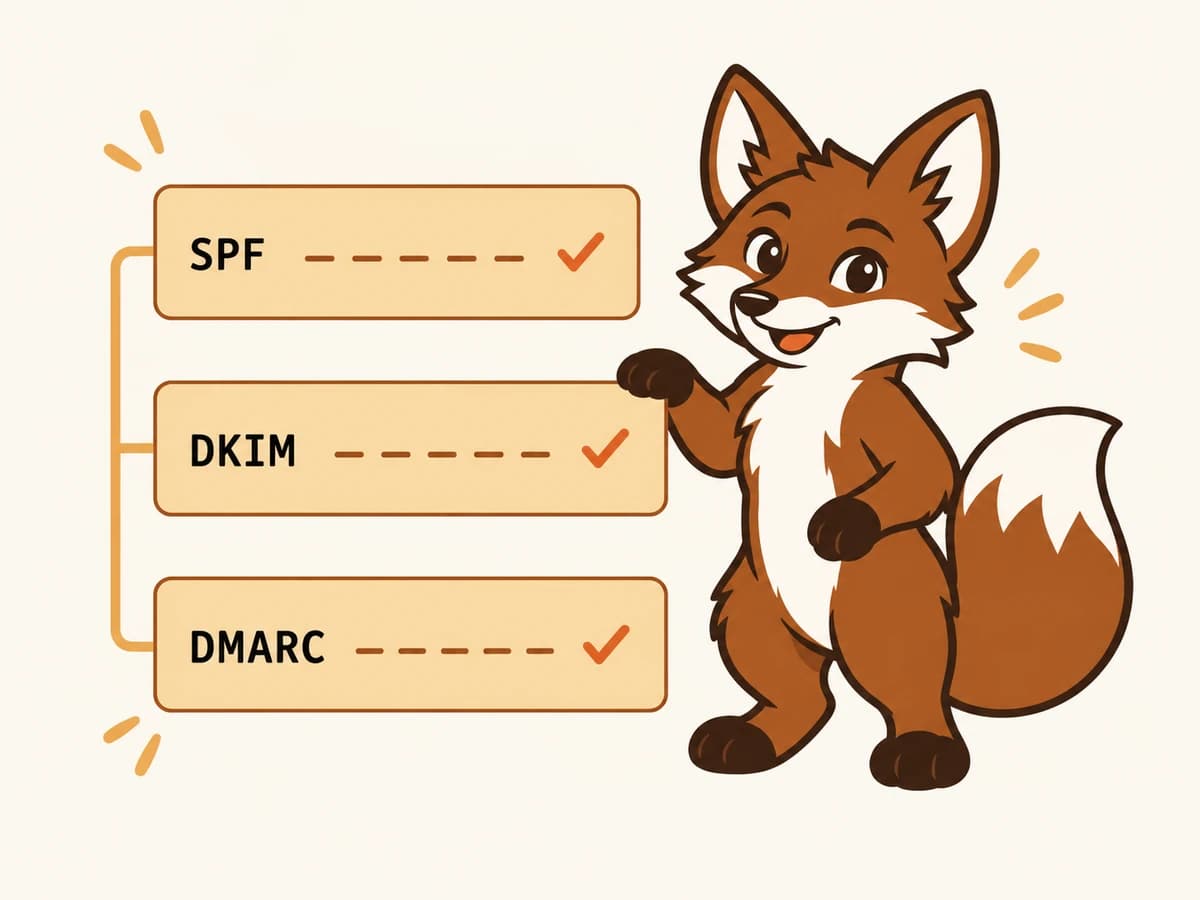
SPF lists the servers allowed to send for you, DKIM signs each message so it cannot be altered in transit, and DMARC tells receivers what to do when a check fails and sends you reports.
Warm each new mailbox
Start with a handful of messages a day and raise the volume over a few weeks, with real engagement, so providers see a normal human pattern.
Clean your list
Verify addresses, remove role mailboxes and anyone who has opted out. Most senders treat a 2% bounce rate as the line to stop and fix.
Cap daily volume per mailbox
A common recommendation is about 30 cold emails per mailbox per day once warm. Our limits guide shows how the numbers add up across a domain.
Put an opt-out and your postal address in every message
It is the law in the US and the UK, and it is the cheapest way to keep spam complaints down.

Which numbers to watch
| Metric | What it tells you | How to read it |
|---|---|---|
| Reply rate | Whether the message fits the person | The number that matters. Count positive replies separately from opt-outs and out-of-office. |
| Bounce rate | List quality | Pause and re-verify if it climbs past about 2%. |
| Spam complaints | Whether people think it is spam | Google tells senders to keep the reported spam rate under 0.30%. |
| Open rate | Weak signal only | Mail apps that preload images can inflate opens, so use it to spot problems, not to judge copy. |
| Meetings or conversations | Whether replies turn into business | The end of the funnel. Tie each campaign to this. |
When not to send a cold email
- Your buyers are consumers, or the people who decide are not reachable by business email. Use ads, partnerships or content instead.
- You cannot say in one sentence why this person should care. Fix the offer before you send anything.
- You have no way to handle replies. A reply you answer three days late costs more than a message you never sent.
- Your product is regulated or sensitive and you have not checked which messages are allowed.
- Your list is bought or years old. It will bounce, and the bounces will follow your domain.
- You need an answer this week. A new sending domain takes weeks to be ready.
Cold email vs other first-touch channels
| Channel | Best for | Weak spot |
|---|---|---|
| Cold email | Reaching a defined business audience one by one | Needs warmed infrastructure and a clean list |
| LinkedIn outreach | Roles that live on LinkedIn, and a softer first contact | Slower and capped by connection limits |
| Cold calling | Time-sensitive offers and high-value accounts | Needs people on the phone, hard to scale |
| Paid ads | Reaching people actively searching | Cost per lead can be high |
| Referrals | Trust, the highest conversion | You cannot produce them on demand |
A pre-send checklist
- The recipient is a business contact, the list is verified, and opted-out people are removed.
- The subject line matches the content and has no hype words.
- The opening line is true and about them.
- There is one ask, and it is small.
- Your name, company and postal address are in the message with a working opt-out.
- SPF, DKIM and DMARC pass for the sending domain.
- The mailbox has been warmed and today's volume is under its cap.
- You sent a test to Gmail and Outlook and it landed in the inbox.
- Someone is ready to read and answer replies the same day.
Common cold email mistakes
Seven habits that sink cold email, and the fix
Avoid
- Sending from your main company domain
- Starting at full volume on a new mailbox
- Writing about yourself for six lines
- Asking for 30 minutes in the first email
- Five identical 'just checking in' follow-ups
- Ignoring opt-outs
- Judging copy by open rate
Do instead
- Use a separate sending domain
- Warm up, then cap daily sends
- One sentence on the reader, one on the outcome
- Ask a yes-or-no question
- Add something new each time and stop at four
- Suppress them everywhere and honor them quickly
- Judge by replies and conversations
Where Warmerly fits
Warmerly handles the parts that decide whether a cold email arrives: mailbox warmup, daily checks of SPF, DKIM and DMARC, and sequences with limits built in, with LinkedIn outreach alongside email in the same tool. Plans start at $19 a month with a 7-day free trial and no charge until day 8. It will not write a good offer for you or fix a list that does not match your market, and if you send a few emails a week by hand, you do not need it yet.
Frequently asked questions
What does cold email mean?
A cold email is a first message to someone you have no prior relationship with, sent to start a business conversation. It is the email equivalent of a cold call. Cold describes the missing relationship, not the tone.
Is cold emailing illegal?
No. In the US, CAN-SPAM allows it, including B2B, if you use accurate headers, a truthful subject line, a postal address and a working opt-out honored within 10 business days. The UK allows it to corporate subscribers under PECR, and many EU countries allow it under legitimate interests. Rules vary by country, and this is not legal advice.
Is cold emailing ok?
It is acceptable when the message is relevant to the person's work, honest about who you are, short, and easy to decline. It becomes a problem when you send identical text to a bought list, hide your identity or keep writing after someone says no.
Do cold emails still work in 2026?
Yes, for a tight audience and a real reason to write. Instantly's 2026 benchmark reports an average reply rate of 3.43%, with good campaigns at 5% to 10%. Results depend on list quality, message fit and whether your email reaches the inbox.
How long should a cold email be?
Most first emails work best at roughly 50 to 125 words: a personal opening line, the reason for writing, one small ask and a signature with an opt-out.
Do I need a separate domain to send cold email?
You should use one. A separate sending domain keeps outreach problems away from your main company email. Publish SPF, DKIM and DMARC for it, and warm each mailbox before sending at volume.